
Your social media is only talking to people who already agree with you.
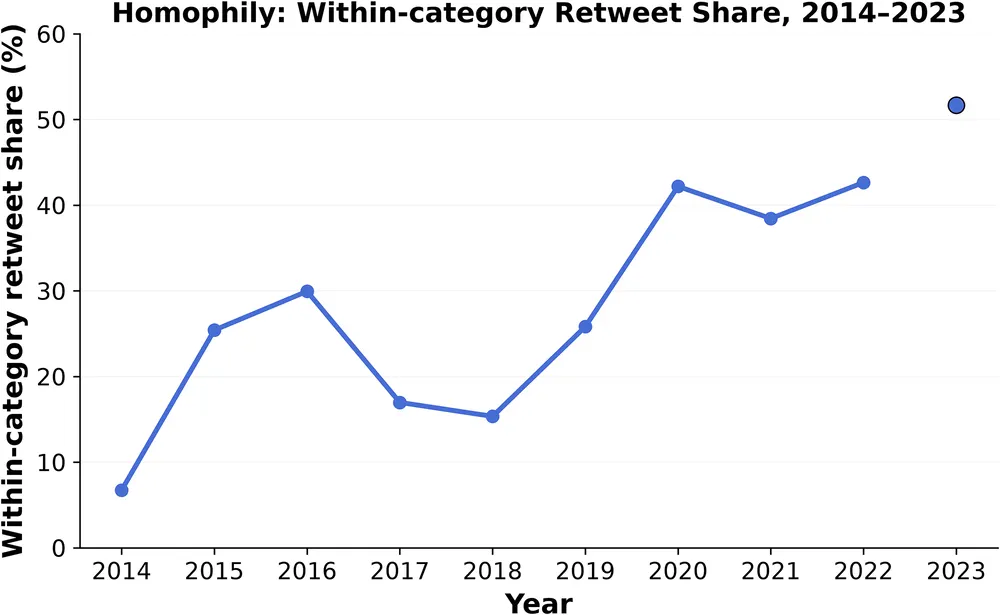
That’s the gist of a new study published in Communications Health on the fragility of organizational social media accounts. The researchers looked at a public health campaign over between 2014 and 2022, and found that within-category retweeting increased from 6.7% to 42.6%, while per-capita amplification for health accounts declined 95.7%. That means that majority of engagement was coming from known supporters of the initiative, while the number of users reached outside of that network fell off a cliff: “These patterns suggest a hardening of category boundaries, where narratives are increasingly confined to internal reinforcement rather than cross-community diffusion.” The number of unique accounts retweeting each of roughly 600 active health accounts fell by about 60% in just one year! They call this the “bunker effect.”
This study backs up similar findings from previous research. A 2023 Nature study found “that the median Facebook user received a majority of their content from like-minded sources—50.4% versus 14.7% from cross-cutting sources.” And a 2021 study found: “The topics of vaccines and abortion, on Facebook and Twitter, respectively, show a strong correlation between the leaning of a user and the average leaning of their nearest neighbors. Similar behavior is found for different topics from the same social media platform.”

A 2022 study, which called these networks “flocks,” looked at follower overlap and engagement among partisan Twitter accounts. On follower overlap, the researchers found: “on average an account of the ‘#Uniteblue’ flock shared 35.2 times more followers with accounts within the flock than with accounts outside the flock; similar results hold for the ‘Christian Constitutionalists.’
These accounts also tended to amplify one another: “Among the 7,379,555 retweeting relationships between accounts… on average, 44.1% were between accounts within a flock… The flocks with low levels of within-flock retweeting retweeted flocks of the same category. For example, 50.6% of retweeting by ‘#Uniteblue’ was of other flocks under the ‘liberals’ category.”
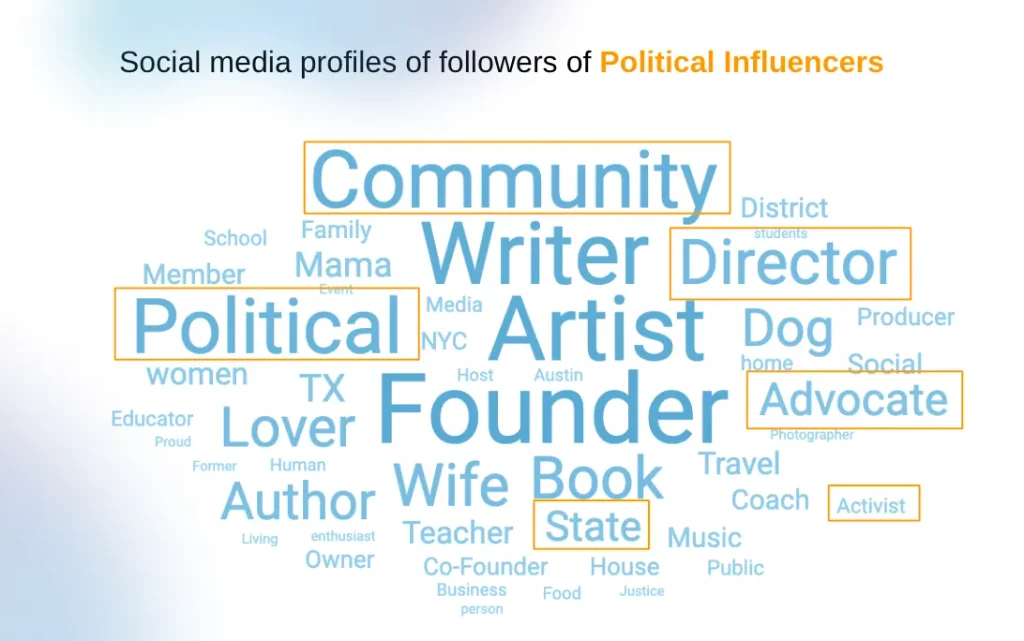
We found very similar results looking at Instagram political vs. non-political creators after the 2024 election: “Followers of political influencers are often political commentators themselves or share content through a political lens. This audience includes a notable mix of established media figures and grassroots activists. The most common self-descriptions among these followers are Political Communications/Media Professionals, Political Activists, and Progressive Content Creators. Notably, 60% of the followers identified themselves as social justice advocates, media professionals, or activists.”
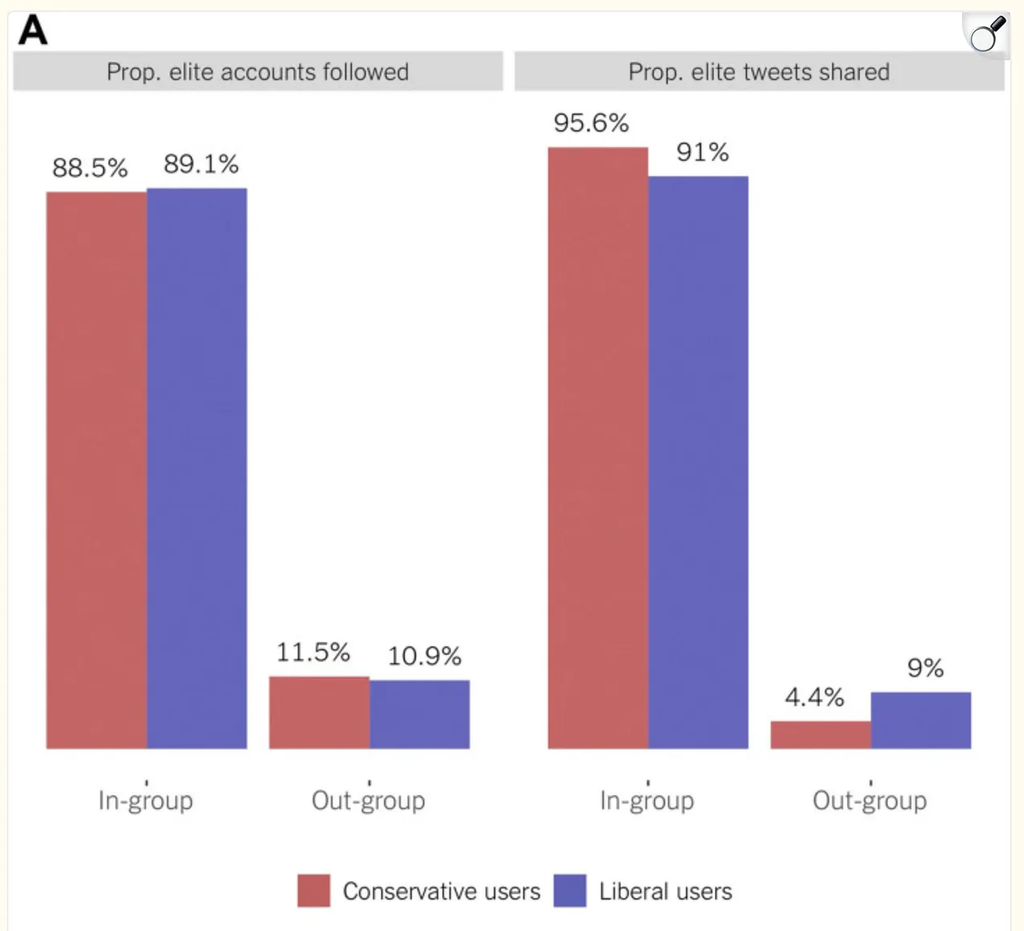
One of the main reasons behind this is that most people just don’t like politics and activism that much. A 2022 study showed that the majority of American Twitter users didn’t even follow a single political elite: “We find that only 40.4% of the users (580,921 of 1,437,774) follow one of these elites or more. The remaining 59.6% follow no political actors whatsoever, although the list includes key politicians (e.g., Donald Trump and Joe Biden), prominent pundits (e.g., Rachel Madow and Sean Hannity), and the most popular media outlets (e.g., MSNBC and Fox News). Only 23% of users follow three or more elite accounts.”
The 40% that did follow political elites, were largely just following and sharing with each other.
So far, I’ve largely talked about how following and engagement are bubbled, but the algorithms are contributing to the problem, too. A 2026 study showed that TikTok begins to feed you videos aligned with your interests within the first 200 videos. After that, the diversity of content on the For You page declined. A 2025 study found “distinct clusters of politically homogeneous networks or ‘political echo chambers’ where users were exposed to attitude-consistent political TikTok content… The echo chambers on TikTok may deepen divisions and increase polarization.”
Popping the Bubble
So, if, like me, you’re convinced that social media has a bubble problem, how can organizations pop it and reach broader audiences?
Most users do enjoy sports and celebrities: “70.7% of the users in our full sample follow at least one of the celebrities in the list, and more than 53.2% follow at least three of them, a stark difference compared to how many follow political elites.”
So, one way is to tie your issue to broader cultural conversations, which can give you both algorithmic pickup and connections to new users. “Organizations that create substantial cultural bridges provoke 2.52 times more comments about their messages from new social media users than those that do not.” A great example of this is the Carnegie Endowment for International Peace’s climate change content, which highlighted extreme weather through a storm chaser, Edgar ONeal.
Most of Edgar’s audience was apolitical and male and weren’t seeing climate change content from established organizations or progressive creators. This aligns with research we’ve done here at People First, showing that non-political creators are able to reach broad audiences who don’t regularly engage with politics or advocacy.
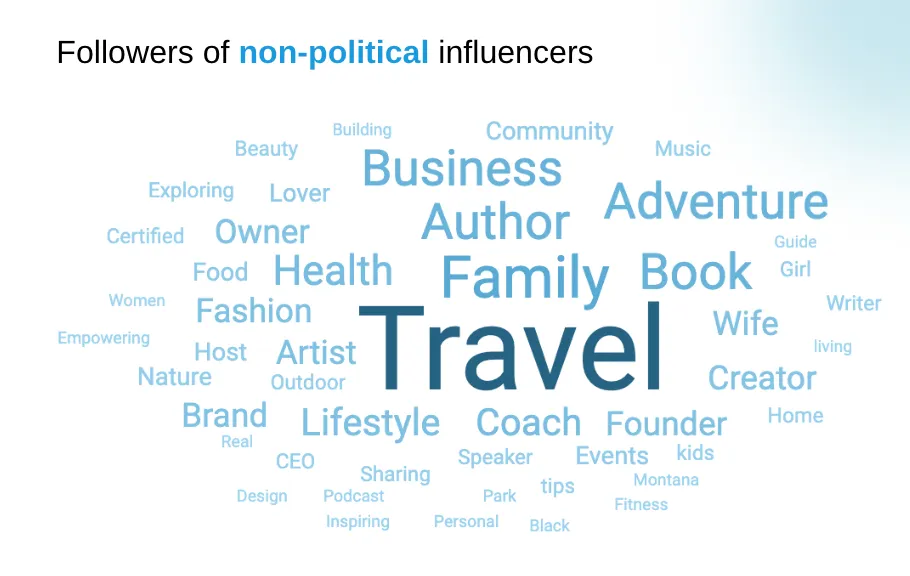
The storm chaser example is something we’ve seen be highly effective, laying the groundwork to open someone’s eyes to a new perspective on an issue by circling through adjacent topics that provide a doorway to the main message. That could mean working with chefs to talk about how great induction ovens are as an entryway to energy conservation, Southern car guys on electric vehicles as an entryway to more efficient vehicles, or suburban homeowners on how much money they’re saving on their electricity bills to discuss renewable energy.
A 2025 study, Mapping the Climate Change Landscape on TikTok, backs up these People First non-political gateway case studies: “Among these, travel-focused creators demonstrate the strongest potential for engaging their audiences with climate-related content, particularly with topics that share semantic proximity to travel, such as oceans, nature, animals, and healthy cooking. Hobby and living-oriented creators show promising pathways for influencing engagement with climate-related content such as healthy cooking, lifestyle, nature and oceans.”
Another approach is working with creators who are demographically similar to or share other affiliations to the audiences you’re trying to influence. A 2026 study looked at the “Effects of Common-Identity Narratives and the Moderating Role of Prior Prejudice” on support for racial justice: “Participants who read the common-identity narrative perceived greater similarity to the character, which increased identification and, in turn, fostered more positive attitudes, greater support for anti-racism movements, and stronger intentions to intervene. The common-identity narrative also reduced perceived social distance from the character, which predicted more favorable attitudes and support intentions for anti-racism movements.” In one of these experiments, it was actually a shared university affiliation that tipped the scale!
Other ways to decentralize your messaging include starting a side quest account. These are cheeky offshoots of your organizational account, built for Gen-Z and young Millennials, where you can share memes, messier content, go off-brand, and experiment with different content types because the account isn’t linked to your main page or followed by all your board members. A stuffier, elder Millennial/Gen-X version of this strategy is the faux news brand, which feels more professional but repackages your content into social-friendly, shareable bites.
Lastly, don’t be afraid to use paid media to get your culturally relevant creator or side quest content in front of audiences who aren’t used to hearing from you. And not just on social. Get into streaming/CTV and gaming, too.
Part of getting out of the bubble is dealing with some negativity, but over time, you’ll begin to reach and persuade these new audiences. And if last week’s results prove anything, it’s that we need to keep talking to these persuadable audiences who don’t normally hear from us.