
I spent two weeks in Brazil in September, and the election was a big topic of conversation with locals in Rio and São Paulo. I left with the sinking feeling that Bolsonaro was going to pull it off, and I wasn’t surprised by the results of the October 4 first round. Living in Bogotá, I see quite a bit of content from Brazil on Twitter and Instagram, and Bolsonaro was all over my feed in the month leading up to the election, while Lula, not so much.
In September, Bolsonaro led in engagement and mentions nearly every day. On Friday, October 2, just two days before the first vote, Bolsonaro generated 5.5 million interactions on social media, compared to Lula’s 170,000. Bolsonaro also outspent Lula on digital ads 3 to 1.
But as I watched the results come in on October 25, I was floored by what Lula had accomplished in just 21 days, becoming the first candidate in Brazilian history to win a second round after losing the first. So, how did he pull off the seemingly impossible? Today, I’m taking a deep dive into the digital strategy pivot that the campaign and key supporters put into motion immediately after the first-round loss.
We’ll start with his social media pivot, celebrities, and spending before getting into the really interesting strategy: his WhatsApp army and how they used it.
A New Social Content Strategy
Lula wasn’t a social-first candidate. He didn’t even own a phone and wasn’t engaged in the digital program during the first-round campaign. That immediately changed, thanks to younger consultants who pushed for a shift, and on Wednesday, October 7, he posted his first direct-to-camera video on Instagram. By the next day, the video had received more than 23 million views, and by October 9, it was approaching 30 million. The campaign would continue posting more authentic, less polished content throughout the runoff.
Brazilian celebrities got into the act, not with weak “voting matters” messaging, but through dramatic content that highlighted some of the worst things about Bolsonaro. One initiative, Revelando (Revealing), featured actors in polished videos telling stories, like the time Bolsonaro defended a cop who killed a 5-year-old girl. And Wagner Moura (star of The Secret Agent to my cultured readers, but Pablo Escobar in Narcos to my… less cultured readers) issued a stark warning that the entire corrupt Bolsonaro family would hand Brazilian autonomy over to the United States.
Paid Media Pivot
Lula immediately increased his paid media spending. Early in the runoff, he outspent Bolsonaro on Meta by roughly 7 to 1. However, Bolsonaro ultimately outspent Lula by about 3 to 1, demonstrating the limits of such small paid media budgets in a country as large as Brazil. Together, they spent only about $1.8 million USD on Meta ads in round two!
Growing Lula’s WhatsApp Army
André Janones, a millennial Brazilian congressman and influencer, launched a WhatsApp channel earlier in the campaign that had grown to 60,000 members by the first round. On October 4, the night it became clear Lula had lost the round one, he posted a video on Instagram telling people that Lula could win the second round and urging them to join Lula’s Army (Exército do Lula) on WhatsApp to be part of the movement to win.
For a few days, he focused on building the channel. By October 6, it had 920,000 members. He called on members to invite their friends: “Each of you has the obligation to bring three people to this channel by Monday. Mother, father, friend, brother, nephew, daughter, son, it doesn’t matter. You’re going to bring three more people here.” By October 7, the channel had more than 2 million members, and Janones was sharing audio messages urging further recruitment.
WhatsApp has insanely high penetration in Brazil, with 93% of the population aged 16 and over using it as a primary communications platform. This compares to just 32% in the United States. WhatsApp is used in a bunch of ways: one-on-one chats like SMS, group chats with friends or family, and broadcast channels like Lula’s Army, where you typically follow a news brand or organization for updates. On a WhatsApp broadcast channel, members can’t post themselves, but they can react and, more importantly, forward posts from the admin (André Janones) to their own friends or group chats, or even share them on their WhatsApp Status for their contacts to see.
Janones called on influencers to get behind the WhatsApp channel and invite their followers to join. He asked them to collaborate with him on Instagram to further expand organic reach. By October 17, the channel had reached 5 million followers.
So, what do you do with an army of online users?
He assigned “missions” to get his army directly involved in decentralizing Lula’s campaign content, breaking out of the bubbles, and defeating the algorithms. Some of these missions included:
- He appeared with Lula in a video on the channel and asked people to share it with their WhatsApp contacts and push it out on Instagram. This was key to the strategy. By having such a wide variety of users engage with and share campaign content, they were able to vastly increase its organic reach and break out of the insular bubbles of people who follow political content on their own. And because many WhatsApp users get notifications of new messages (this is where they talk to their friends and book doctor’s appointments, after all), the content could spread without any algorithmic interference.
- Other missions focused on Twitter (X), asking users to post content and promote specific hashtags. And not all of these hashtags were designed to speak to the already converted. They also focused on hashtags used by the Bolsonaro team (#FlávioBolsonaro or #BrasilPátriaAmada) and neutral election hashtags like #EleiçõesBrasil2026.
- They also focused on getting content into insular Facebook groups to reach older and less politically engaged voters
- While there was plenty of pre-made content that made it easy for users to share, people with specific interests and fandoms (groups of fans of Taylor Swift and Beyonce) were encouraged to create content that spoke to their own audiences. Businesspeople spoke to other businesspeople, healthcare professionals wearing their uniforms spoke to other HCPs, farmers spoke to farmers, religious leaders used Christian metaphors, comedians made jokes, and Indigenous and LGBT creators spoke to their communities.
- Users with larger accounts collaborated with smaller niche creators, from hairdressers to pet sitters, to help expand their reach and get content in front of crucial undecided voters and people who hadn’t voted in the first round.
- The channel focused on making members better political communicators, online and off. That meant everything from issuing guidance on how to communicate online, including not engaging with far-right content because doing so increases its reach, to sharing PDFs on how to talk to non-voters and undecided voters in real life.
- This isn’t to say Lula’s Army was only focused on online actions. The group supported the massive street demonstrations in Rio and São Paulo, as well as the more than 1,700 demonstrations held the weekend before the vote alone.
On October 23, during the final televised debate, Flávio Bolsonaro made his fatal mistake. He mocked Lula for having only nine fingers, after Lula lost one as a young man working overtime in a factory and not receiving adequate medical care. For Flávio, an objectively unimpressive nepo baby who has never had a job, this played poorly with the tens of millions of Brazilians who didn’t inherit a “career” and cash from their corrupt families.
The WhatsApp channel was key to making sure every Brazilian saw this exchange, spreading the video with the hashtag #SomosTodos9Dedos (We Are All Nine Fingers). The message became even more authentic when supporters shared pictures of their own amputated fingers.
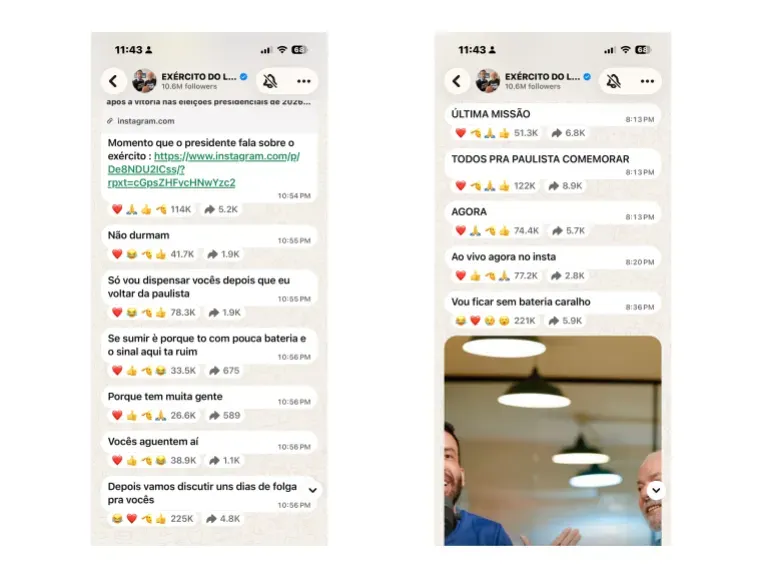
Janones closed the campaign with an epic 24-hour livestream on YouTube that brought together celebrities, politicians, and influencers and racked up nearly 22 million views (peaking at 775,000 concurrent viewers). During the broadcast, they continued to give viewers actions to take to drive last-minute turnout, including asking them to clip and share their favorite moments, talk to undecided voters in their lives, get out on the streets for final mobilization events, and engage with specific content across social networks. At one point, Janones even took a nap while guest hosts took over.
Lula was able to mobilize nearly 3 million more Brazilians to vote in the runoff than in the first round. Plus, nearly 2 million fewer people cast blank or invalid ballots. In the final count, Lula picked up 10.4 million additional votes, 6.6 million more than Bolsonaro gained, allowing him to win by 4.4 million votes.
On the digital side, all the digital relational organizing seemed to pay off. From October 5 to 18, positive posts about Lula rose from 20% to 30%, while negative content fell slightly from 31% to 30%. Flávio’s digital went the other way: positive mentions fell from 44% to 39%, while negatives increased from 27% to 34%.
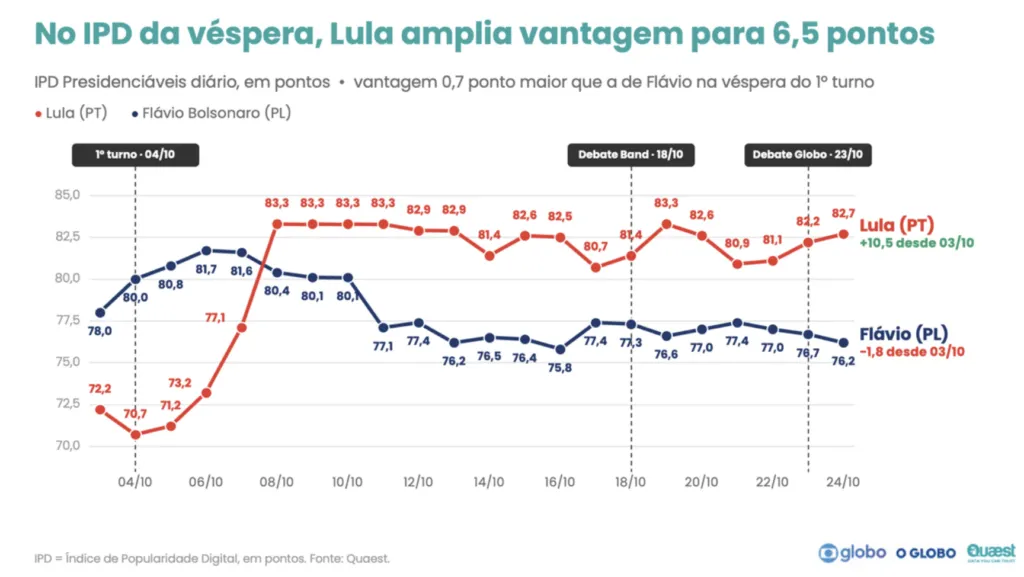
This Digital Popularity Index shows the digital turnaround even more clearly. Lula went from 5.8 points behind Bolsonaro before the first round to 6.5 points ahead of him directly before the runoff, a 12.3-point gain in just a matter of weeks.
What Democratic Campaigns Can Learn from the Runoff
What really stands out about Lula’s impressive runoff victory is less about broadcast social media and more about decentralized organizing.
Unfortunately for us, WhatsApp isn’t nearly as viable as a national organizing channel. To reach that kind of scale, you’d need to onboard people onto an app they don’t already use or have thousands of connections on. You can’t imagine someone in the U.S. directly messaging 1,500 people on WhatsApp the day before the election, as one Brazilian did: “That message was a last gasp I sent to work contacts, all kinds of service providers, former flings, friends, family.”
Instagram Broadcast Channels are the closest match, but they currently cap membership at 1 million. (For statewide campaigns and niche group organizing, a one-million-member cap doesn’t seem like a limit that would ever be hit.) Facebook Messenger Broadcast Channels don’t have a clear member limit, so they’re an option worth exploring. YouTube Communities don’t allow frequent enough posts to work as a rapid-response channel. SMS at scale is very expensive.
Decentralization of content production is something we’ve already seen in successful campaigns in the U.S., and it featured prominently in Lula’s victory:
“The graphic ammunition, videos, and images from thousands of designers and creatives were compiled on drives and sites like Acervo da Vitória, Designers pela Virada, Vira Voto – Artes Digitais, and Design Ativista. Drives for lambes (posters to put up in the streets) also proliferated, such as Lambes pela Virada and Lambes Antifascistas. However, a new development compared to 2022 was the centralization of this dispersed material. Diretorio13.com and Acervo Lula compiled initiatives, especially graphic and audiovisual ones.” But, once you have the content, you still need a decentralized way to share it and get it in front of the right audiences.
Engaging non-political creators to get out of the bubble was another key strategy of Lula’s team, allowing them to reach folks outside the leftist bubble. I’ve written about this extensively.
Not engaging or, even worse, amplifying your political opponents by quote-tweeting them is something we can all learn from. Just a few hours ago, a former candidate who lost the Michigan Democratic Senate primary went bonkers and endorsed the MAGA Republican because her feelings were hurt. Almost immediately, Democrats and other leftists began to quote-tweet her endorsement video with “witty quips” and sanctimonious callouts.
Channeling my inner Janones, I went to Democratic nominee Abdul El-Sayed’s Twitter and shared some of my favorite posts from his campaign instead.
As of this writing, her endorsement of the MAGA Senate candidate has received almost 5 million views in an hour, easily on its way to becoming her biggest post of all time, largely thanks to sharing by Democrats who support Abdul. You’re not helping.
As Democrats head into 2028, I hope more campaigns embrace creating a real community, giving people online and offline actions they can take, and not strictly using their SMS and email lists as ATMs. That means making asks, from the simple to the hard, rewarding your strongest advocates, and creating opportunities for everyone to get involved. “Eu sou um de vocês. Vamos juntos!” (“I am one of you. Let’s do this together!”)